
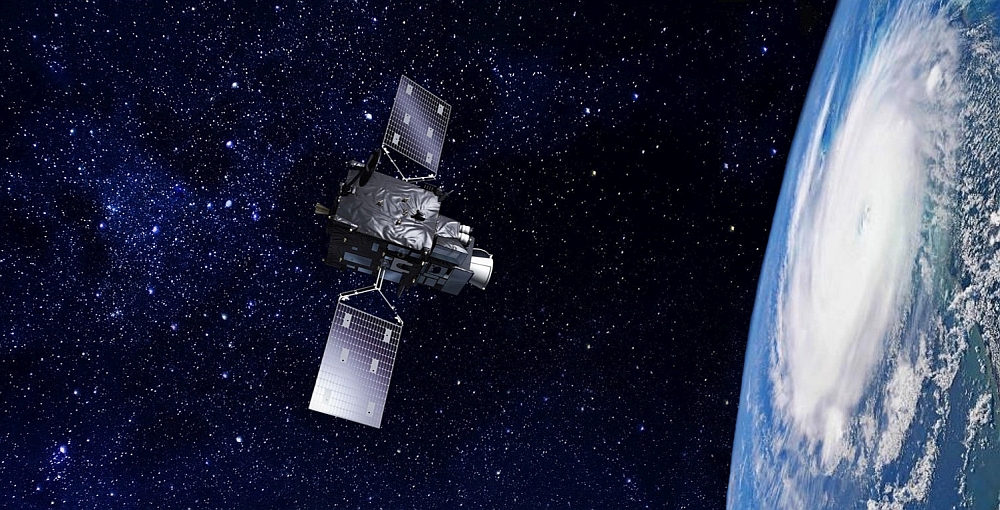
- The MTG-I2 meteorological satellite was launched into orbit on August 27, 2026, by an Ariane 62 rocket from the Kourou space center in French Guiana.
- Designed by Thales Alenia Space as part of a joint program between the European Space Agency (ESA) and Eumetsat, the satellite incorporates four infrared detectors developed by the Grenoble-based company Lynred within its primary instrument, the Flexible Combined Imager (FCI).
The role of the supplied detectors is to capture images across eleven distinct spectral bands, covering an optical range extending from near-infrared (NIR) to very long-wave infrared (VLWIR)—wavelengths reaching up to 13.3 µm. The technologies employed rely on mercury-cadmium-telluride (MCT) arrays qualified to withstand the environmental stresses of space.
These components enable the measurement of air mass movements, the analysis of cloud cover structure, and the measurement of humidity variations at various altitudes. The collected data feed into numerical forecasting models used to monitor atmospheric phenomena such as storms and tropical depressions.
“The technologies developed under the MTG program allow us to offer a range of multispectral sensors that meet the needs of numerous environmental and scientific missions,” states Philippe Chorier, Head of Space Business Development at Lynred.
MTG Constellation Architecture and Observation Cadence
The launch of MTG-I2 completes the initial set of the Meteosat Third Generation (MTG) family, which comprises two imaging satellites (MTG-I1, commissioned as Meteosat-12, and MTG-I2) and one sounding satellite (MTG-S1). The joint operation of the two imaging satellites reduces the refresh rate for weather maps over the European continent to 2.5 minutes, compared to 15 minutes with the previous generation (Meteosat Second Generation).
Specifications of detectors on board MTG-I2
- NIR detector: Spectral bands at 1.3 µm, 1.6 µm, and 2.2 µm.
- IR1 detector: Spectral bands at 3.8 µm, 6.3 µm, and 7.3 µm.
- IR2 detector: Spectral bands at 8.7 µm and 9.7 µm.
- IR3 detector: Spectral bands at 10.5 µm, 12.3 µm, and 13.3 µm.
- Program overview: 26 detectors designed by Lynred for the entire MTG program (FCI and IRS instruments), 10 of which are currently operational in orbit.