
- Rohde & Schwarz and Realtek have announced the development of a dedicated testing solution for the Bluetooth® LE High Data Throughput (HDT) feature.
- This technology, integrated into the next generation of the Bluetooth® LE standard, increases the maximum data transmission rate from 2 Mbps to 7.5 Mbps.
This opens up new possibilities for applications such as low-latency audio streaming, fast media file sharing, and over-the-air (OTA) software updates.
HDT delivers up to four times the transmission capacity of previous versions, while optimizing energy efficiency, spectrum usage, and transmission reliability. The new Bluetooth® LE physical layer (PHY) will support five distinct data rates, ranging from 2 to 7.5 Mbps, thanks to the introduction of three modulation schemes and different levels of error correction.
Chip Adapted to New Requirements
Realtek offers two hardware solutions compatible with HDT:
- The RTL8922D chip, which combines Wi-Fi and Bluetooth technologies, supports channel management and the requirements of the IEEE 802.15.4 standard. It enables simultaneous Wi-Fi, dual Bluetooth, and Zigbee/Thread connectivity, suitable for PCs, TVs, game consoles, vehicles, and home automation devices.
- The RTL8773J chip, a system-on-a-chip dedicated to Bluetooth audio, integrates BT Legacy, Bluetooth LE, LE Audio, and HDT technologies. It offers optimized audio processing in terms of power consumption and latency, while meeting HDT specifications.
A Versatile Test Platform
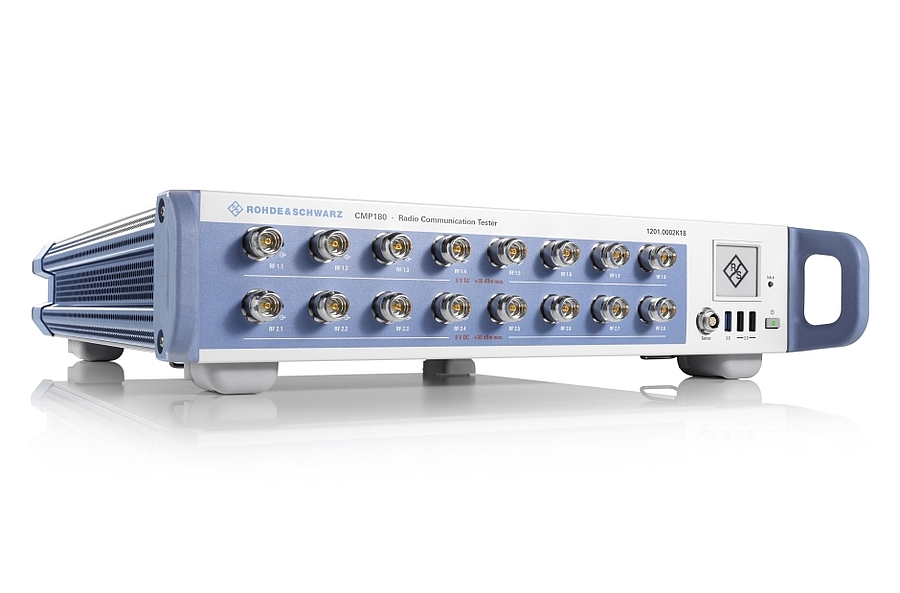
The Rohde & Schwarz CMP180 tester is designed to meet the testing needs of R&D, pre-compliance, and series production. It supports various communication technologies, including Wi-Fi 8 and 5G NR FR1 up to 8 GHz, with bandwidths up to 500 MHz. For Bluetooth® LE, it enables testing in Direct Test Mode (DTM) and via a chipset-specific controller. It is also compatible with the Universal Test Protocol (UTP).
The CMP180 integrates two analyzers, two generators, and two sets of eight RF ports in a single package.
The Bluetooth® LE HDT testing solutions were presented at Mobile World Congress 2026 (March 2-5, Barcelona) and will be showcased at embedded world (March 10-12, Nuremberg).