
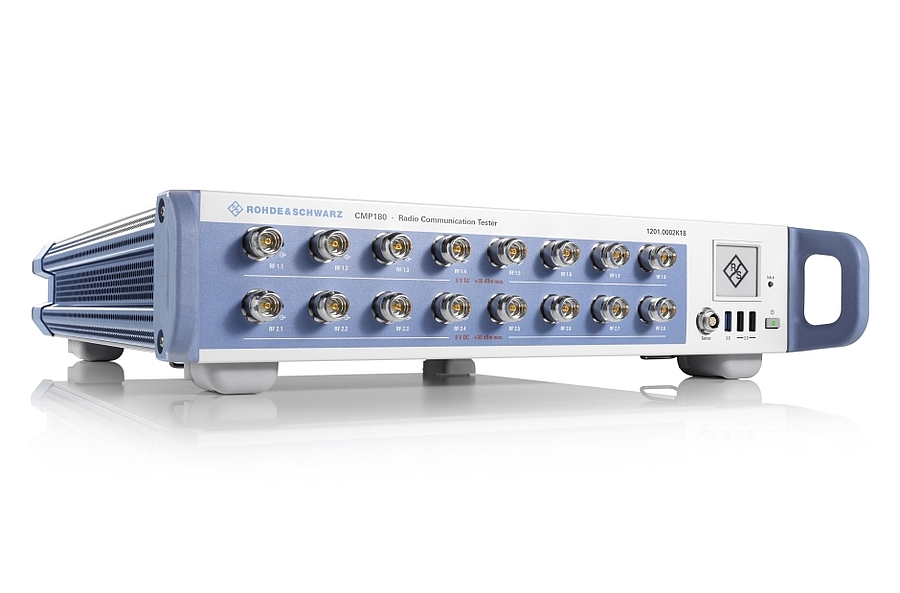
- Netgear has selected Rohde & Schwarz‘s CMP180 radio communication tester for the development of its future Wi-Fi 8 access points.
- This collaboration aims to accelerate the development of Wi-Fi 8 products that deliver optimal performance.
Wi-Fi 8, the next generation of Wi-Fi technology, is based on the upcoming IEEE 802.11b standard. This new technology will enhance the user experience of wireless communication applications deployed in homes, offices, and factories. It aims to guarantee high-speed connectivity in all circumstances with low latency for educational and professional applications, as well as gaming, which will leverage augmented reality (AR) and virtual reality (VR) solutions to provide an immersive user experience.
Testing Requirements for Wi-Fi 8 Access Points
Validating Wi-Fi 8 access points during the design phase requires test solutions that support the latest Wi-Fi 8 features, such as Distributed Resource Units (DRUs) and Unequal Enabled Modulation (UEQM), with support for channel widths up to 320 MHz across all covered bands and the most sophisticated modulation schemes (4096QAM). These solutions must also guarantee the performance (EVM) and scalability (4×4 MIMO) necessary to optimize the performance of wireless communication devices.
Netgear’s Chosen Testing Solution
For testing its Wi-Fi 8 access points, Netgear uses the Rohde & Schwarz CMP180 series radio communication tester, a scalable, signalless test solution for wireless communication devices, suitable for use in R&D, validation, and production phases. This tester supports a wide range of cellular and non-cellular communication technologies, including the latest Wi-Fi 6E, Wi-Fi 7, Wi-Fi 8, and 5G NR FR1 standards, across frequency bands up to 8 GHz and bandwidths up to 500 MHz.
CMP180 Tester Features
The CMP180 tester integrates two analyzers, two generators, and two sets of eight RF ports into a single unit. These capabilities can be expanded by using multiple testers. With its ability to quickly test multiple devices, it is well-suited for serial production lines. It can also be used throughout the entire development cycle: from Engineering Validation Testing (EVT) to Design Validation Testing (DVT) and Production Validation Testing (PVT), all the way to Serial Production (MP).