
- The modernization of high-performance computing infrastructures and data centers for artificial intelligence necessitates an evolution of communication standards.
- To meet these requirements, Keysight Technologies has announced the expansion of its measurement offering with a dedicated receiver (RX) testing solution for the PCIe 7.0 standard. This service aims to validate signal integrity at a transfer rate of 128 GT/s.
The transition to the PCIe 7.0 specification reduces engineers’ room for maneuver due to the complexity of very high-frequency signals. At data transmission rates reaching 128 GT/s, stress signal calibration becomes a critical step to ensure component interoperability. Receiver validation involves verifying the ability of a specific integrated circuit (ASIC) to correctly interpret data despite the disturbances and signal losses inherent in printed circuit boards.
Hardware and Software Solution Architecture
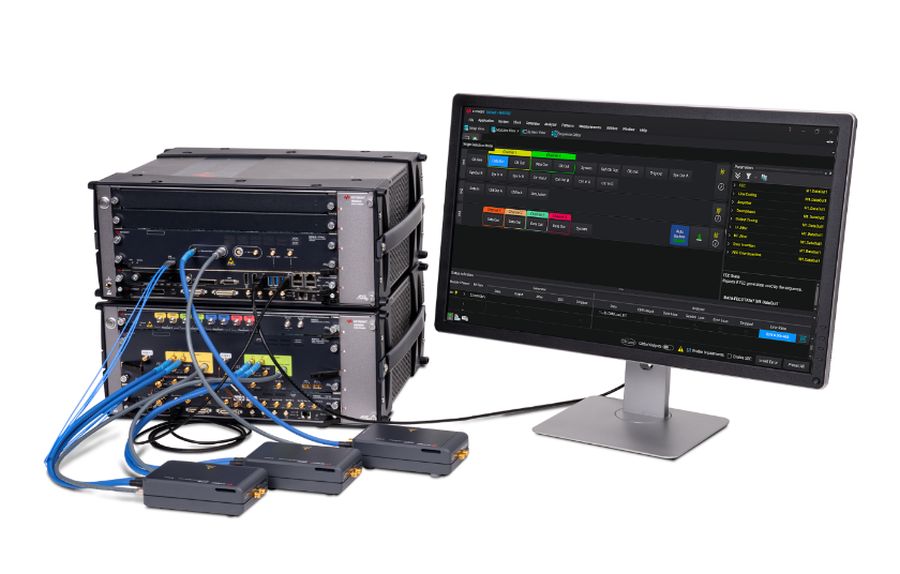
Keysight’s solution is based on a combination of measurement instruments and software automation tools. The hardware component relies on the M8050A series bit error rate tester (BERT), complemented by the M8042A family pattern generator (operating at 120 GBaud) and the M8043A series error analyzer. This combination generates accurate data streams for analyzing ASIC response under stress.
On the software side, the N5991PB7A application automates signal control and calibration. This software layer reduces the manual configuration required to establish stress tests, resulting in more repeatable characterization results. The system is designed to operate in common-clock mode, a standard configuration in PCIe architectures.
Operational Objectives and Compliance
The integration of these RX testing capabilities complements existing transmitter (TX) solutions, providing end-to-end validation coverage for the PCIe 7.0 physical layer. The goal is to detect potential design weaknesses early in the ASIC development cycle, thereby minimizing the need for costly modifications at the end of the project.
By automating workflows, the solution enables developers to comply with the PCIe 7.0 specification requirements while accelerating receiver deployment phases.