
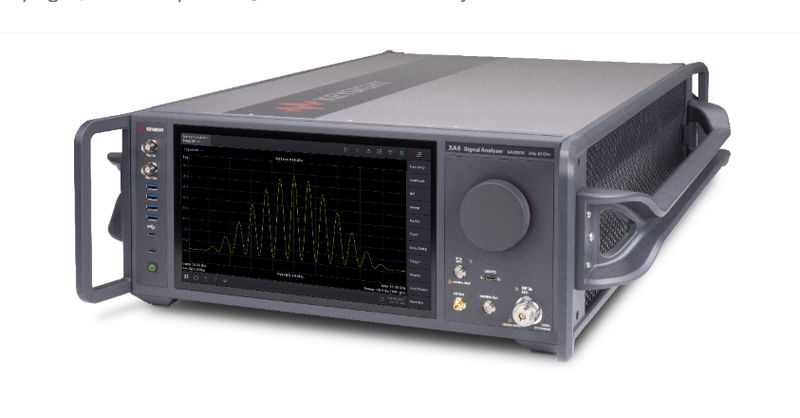

- Keysight Technologies has announced the launch of two new signal analyzers in the Pro Series XA6 SA6320A and Expert Series XA5 SA6210A, designed for development applications in broadband wireless transmission systems.
- These instruments are designed to assist engineers in the design, debugging, and validation phases of wireless communication systems, whose complexity is increasing due to wider bandwidths, higher frequencies, and the adoption of multi-antenna architectures.
These signal analyzers aim to reduce measurement uncertainties and accelerate the identification of signal degradation during the characterization of wireless, radar, and broadband systems.
Technical Specifications of the Pro XA6 SA6320A Analyzer
Designed for electromagnetic spectrum management, radar, and millimeter wave applications, the Pro XA6 SA6320A features the following specifications:
- An analysis bandwidth of up to 8 GHz for capturing broadband signals.
- Frequency coverage extending up to 67 GHz with full preset.
- Optimizations for Displayed Average Noise Level (DANL), phase noise, and Error Vector Amplitude (EVM) for detecting low-level spurious signals and interference.
- Graphics Processing Unit (GPU)-accelerated demodulation speed for analyzing 5G NR EVM measurements.
- A maximum Resolution Bandwidth (RBW) of 80 MHz to meet regulatory signal measurement requirements.
Technical Specifications of the Expert XA5 SA6210A Analyzer
Optimized for daily R&D, validation, and manufacturing activities in the fields of 5G, WLAN, UWB, and pulsed RF signals, the Expert XA5 SA6210A offers the following features:
- Imageless scanning measurements up to 32 GHz for locating spurious emissions.
- A maximum analysis bandwidth of 2 GHz.
- An integrated dual-receiver architecture on a single platform, enabling MIMO measurements (5G NR and WLAN) as well as correlated EVM (ccEVM) analysis.
- An updated user interface, a larger screen, and compatibility with the SCPI programming language of previous X-series models to simplify the transition for test teams.