
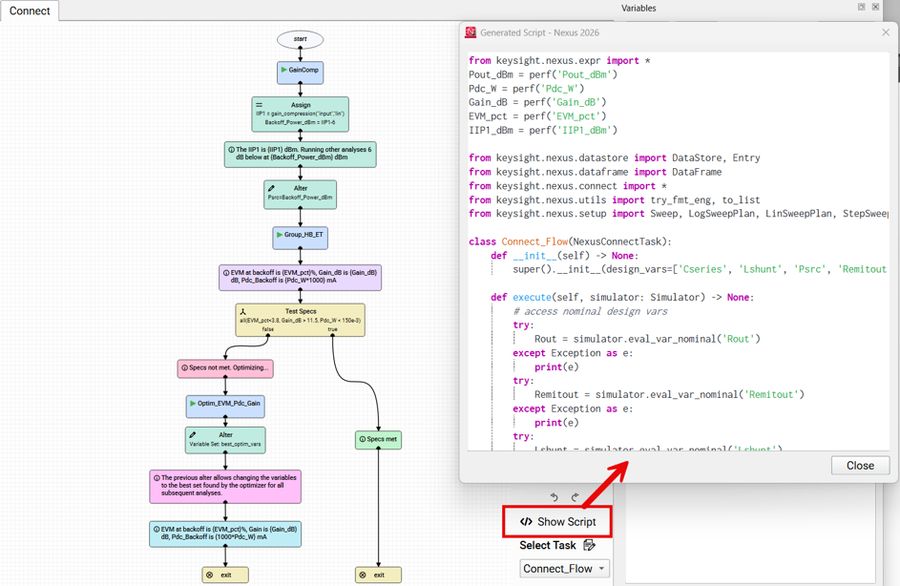

- Keysight Technologies has developed a new feature for its RF Circuit Simulation Professional software. Taking the form of an executable whiteboard, this tool allows engineers to record and graphically structure their radio frequency (RF) circuit design process.
This software initiative comes amidst a tight labor market in the semiconductor sector. According to projections by McKinsey, the semiconductor industry will face a shortage of 88,000 engineers by 2029. The field of RF design is particularly affected, as mastering multi-physics simulation methodologies requires several years of experience, which poses a challenge in transferring skills when experienced engineers leave.
“RF design expertise is leaving the sector faster than it is being replaced,” explains Nilesh Kamdar, General Manager of the EDA division at Keysight. “The simulation knowledge accumulated by senior engineers cannot be conveyed solely through documentation. Design teams now have a way to capture this experience as a visual, executable, and reusable workflow.”
Process Capitalization and Automation
The feature introduced by Keysight captures the user’s decision-making process by sequentially archiving simulations performed, optimizations applied, decision trees, and parameter adjustments. At each step, the system generates a Python script. This code remains editable, can be shared, and integrates with third-party and internal design environments such as Keysight Advanced Design System, Cadence Virtuoso, and Synopsys Custom Compiler.
Development teams can thus model their workflows as automated scripts that support conditional loops. This approach automates previously manual configuration phases, such as design reviews and tape-out steps, which are now performed iteratively.
Structuring Data for Machine Learning
Beyond preserving methodologies within teams, formalizing these workflows aims to prepare for the integration of more advanced automation technologies. The structured data generated from this whiteboard, combined with the resulting Python APIs, will serve as the technical foundation for training artificial intelligence and machine learning algorithms dedicated to circuit design.