
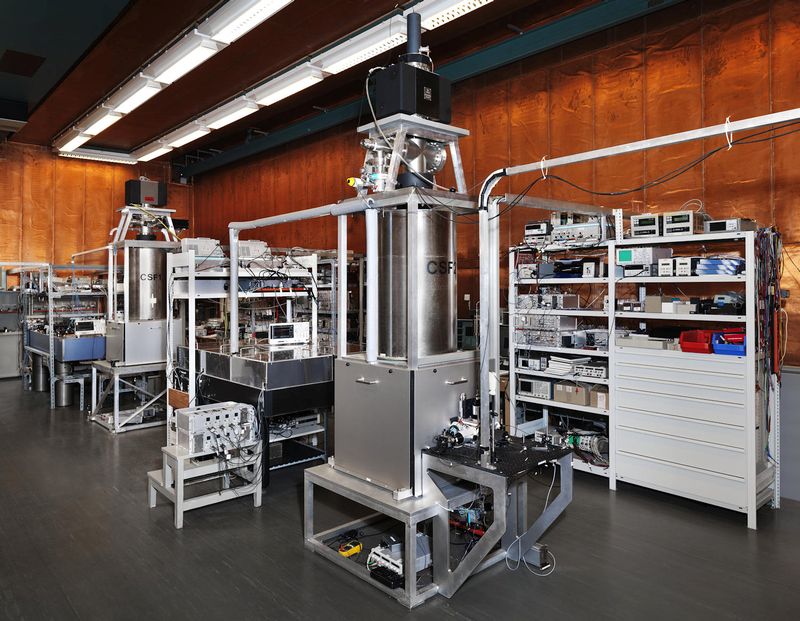

- Germany’s national metrology institute (Physikalisch-Technische Bundesanstalt, PTB) has overhauled the electronic architecture of its CSF1 and CSF2 cesium fountain atomic clocks, which serve as the reference for legal time in Germany.
- PTB replaced its dedicated analog circuits with PXIe-format signal generation cards supplied by Spectrum Instrumentation.
Photo caption: PTB’s two cesium fountain clocks provide the legal time for the entire Federal Republic of Germany.
The CSF1 and CSF2 clocks measure the fundamental transition frequency of the cesium-133 atom (defined as 9,192,631,770 Hz) to drive the national UTC (PTB) time scale. The process relies on a continuous 1.2-second cycle involving the laser cooling of an atom cloud, its vertical launch, its passage through a Ramsey microwave cavity, and its measurement via fluorescence spectroscopy.
Previously, the manipulation of laser frequencies required for cooling, launching, and detecting the atoms was controlled by custom-designed analog cards. Maintenance complexity and the obsolescence of these proprietary electronic circuits prompted PTB to seek a standardized digital solution capable of managing the acousto-optic modulators (AOMs).
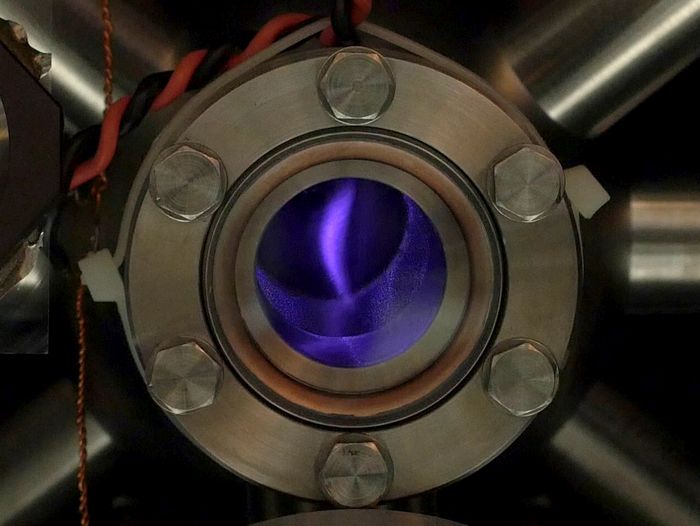
Hardware integration and sequence mode development
PTB selected the M4x.6622-x4 series arbitrary waveform generator cards in PXIe format from Spectrum Instrumentation. During integration, the institute encountered a lack of a native signal generation mode capable of handling the strict timing requirements of the lasers throughout the 1.2-second cycle.
To overcome this obstacle, engineers at Spectrum Instrumentation developed a specialized software mode known as “Sequence Restart Mode.” This feature allows complex waveform sequences to be interrupted and restarted in response to an external trigger, thereby meeting the sequencing requirements for the cooling and spectroscopy stages. The option was implemented via a driver update for all cards in the German manufacturer’s AWG 65xx and 66xx series.
Specifications of the M4x.6622-x4 series signal generator
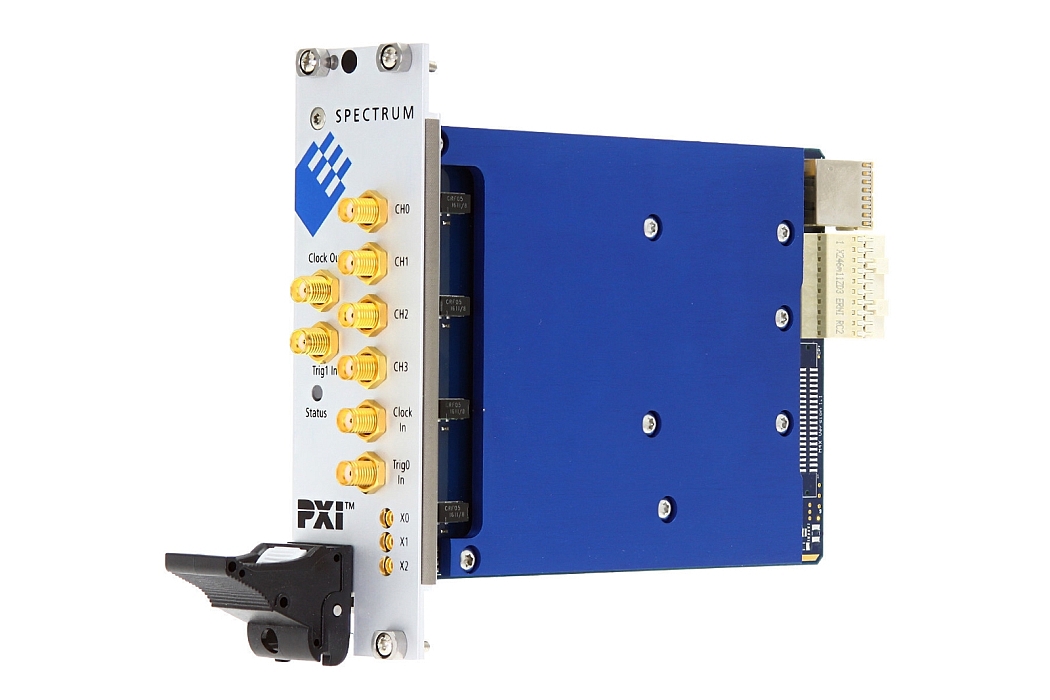
- Up to 625 MS/s on 4 channels
- 16 bit arbitrary waveform generator
- Simultaneous signal generation on all channels
- Output level ±160 mV to ±5 V (625 MS/s) or ±4 V (1.25 GS/s) into High Impedance
- Output level ±80 mV to ±2.5 V (625 MS/s) or ±2.0 V (1.25 GS/s) into 50 Ohm
- Fixed trigger to output delay
- Multi-carrier DDS option available
- Single-Shot, Loop, Gated, Sequence Mode
- Marker Output, Digital Outputs
- Sustained streaming mode more than 1.7 GB/s
- Direct data transfer from CUDA GPU using SCAPP
- PXIe x4 Gen 2 Interface
- AWG/Digitizer: Sustained streaming mode more than 1.7 GB/s
- DDS:Transfer Speed of up to 10 Million DDS Commmands per second
- Works with all PXIe and PXI hybrid slots
- PXIe 3U format, 2 slots wide