
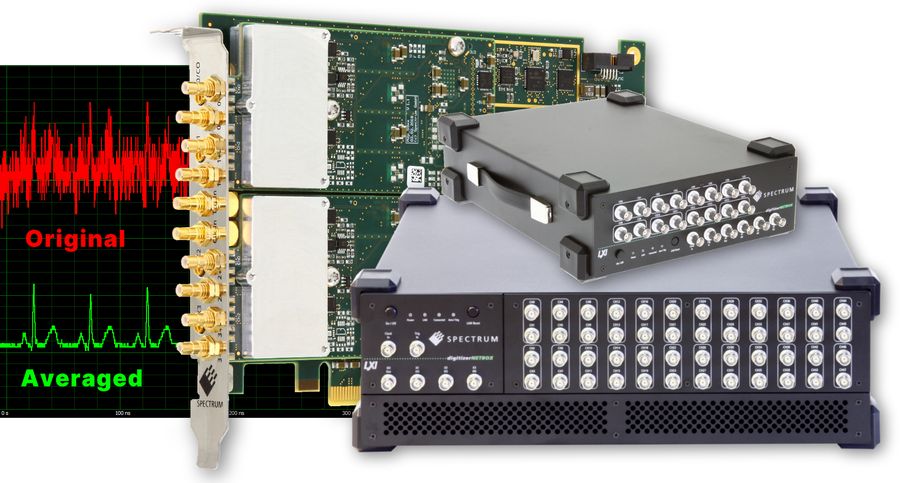
- Spectrum Instrumentation has introduced a new software option that enables summation averaging to be performed directly within the FPGA of its 59xx series digitizers.
- This feature is designed to improve the signal-to-noise ratio (SNR) when acquiring low-amplitude, repetitive signals, while simultaneously reducing the volume of data that must be transferred to a computer for processing.
- The option is available across all 52 models in the digitizer series, which are offered in both PCIe and Ethernet (LXI) formats.
Averaging involves combining multiple synchronized acquisitions of the same signal to reduce the influence of uncorrelated, random noise. When a signal repeats consistently, this process reveals details that would otherwise be obscured by noise in a single-acquisition capture.
Because the processing takes place within the digitizer’s onboard FPGA, waveforms can be averaged without the need to transfer every individual acquisition to a host system. According to Spectrum Instrumentation, the function supports signals with repetition rates of up to 2 million events per second, with waveforms of up to 64 kS (kilosamples) per acquisition.
Improving the Signal-to-Noise Ratio
Under ideal conditions—with a repetitive signal and uncorrelated random noise—the signal-to-noise ratio improves in proportion to the square root of the number of averaged acquisitions. For instance, averaging 64 acquisitions can yield a 12 dB improvement in the signal-to-noise ratio, which is equivalent to gaining approximately two additional bits of effective resolution.
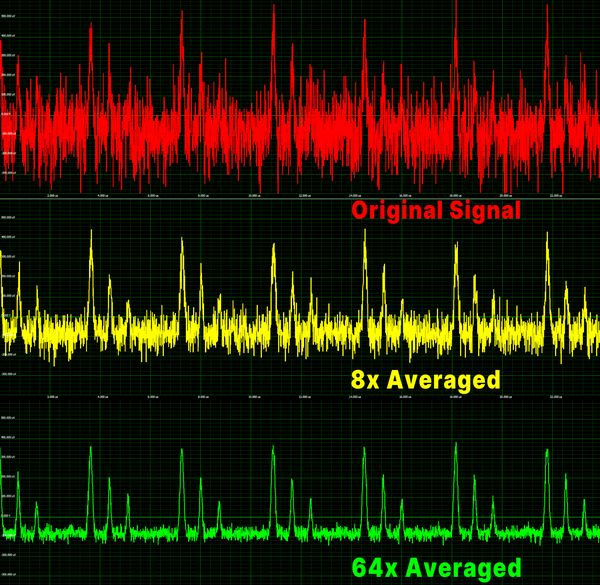
The German manufacturer illustrates this function using a signal of approximately 300 µV, acquired at 125 MS/s by an M2p.5962 series digitizer. Initially buried in noise, the signal reveals three pulses spaced 3.6 µs apart after averaging eight acquisitions. Processing 64 acquisitions makes it easier to distinguish a pulse of approximately 300 µV, followed by lower-amplitude pulses.
This method is particularly well-suited for applications involving weak signals or temporal details that are difficult to discern—such as lidar, mass spectrometry, radio astronomy, radar, sonar, communications, and nuclear physics.
An option for the 52 models in the product line
The 59xx series digitizers feature 16-bit resolution and maximum sampling rates ranging from 5 MS/s to 125 MS/s. PCIe-format models offer between one and eight input channels, while the standalone (boxed) instruments with Ethernet connectivity provide between four and 48 channels. PCIe cards can be synchronized using the “Star-Hub” system to create acquisition architectures with up to 128 channels. Continuous data transfer to a PC or a graphics processing unit (GPU) can reach speeds of up to 700 MB/s.
The software option—designated M2p.xxxx-spavg—is available for new instruments and can also be installed on existing digitizers. Integrated averaging allows acquisitions to be processed prior to data transfer, which is especially useful when signal repetition generates a large volume of measurements.