
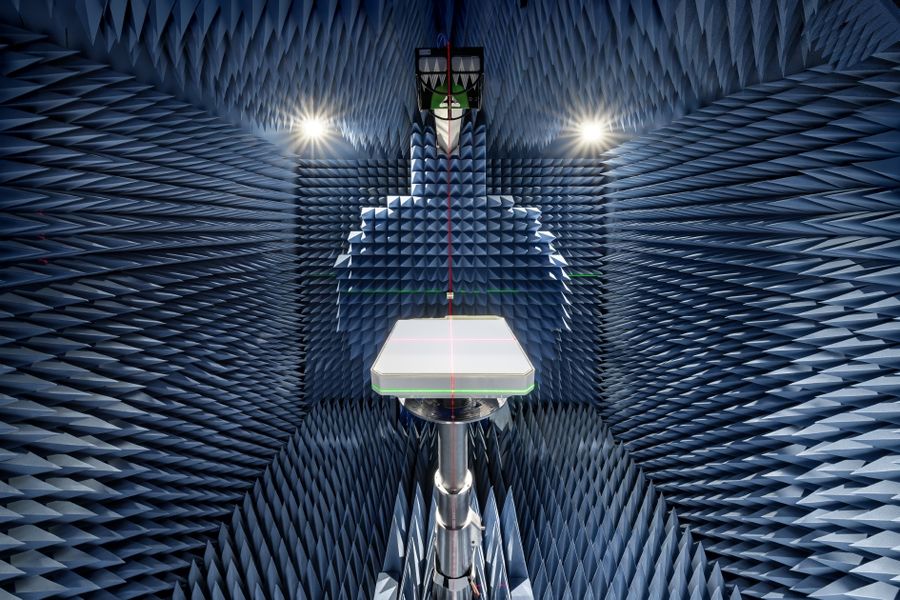
- Rohde & Schwarz and Greenerwave conducted a joint measurement campaign demonstrating that a near-field test system can characterize the complete radiation pattern of a 50 cm Ku-band electronically steerable array (ESA) in just 30 minutes.
- The results obtained match simulation models to within 1 dB, thus offering a fast and reliable alternative for verifying Satcom antenna performance without requiring large anechoic chambers.
Electronically Steerable Arrays (ESAs) are playing an increasingly important role in satellite communication (Satcom) systems, particularly for LEO, MEO, and GEO orbits. However, their precise characterization poses a major challenge: traditional far-field testing requires anechoic chambers with dimensions often incompatible with industrial constraints, particularly for large antennas (50 cm or more). Compact Antenna Test Ranges (CATRs), while more compact, remain bulky and require lengthy and time-consuming dual-axis positioning to map the radiation pattern.
Greenerwave develops Satcom user terminals based on reconfigurable intelligent surfaces (RIS), enabling the design of low-power ESA antennas that are less dependent on semiconductors than conventional solutions.
A validated near-field testing solution
For this measurement campaign, Rohde & Schwarz provided its R&S TS8991 system, dedicated to over-the-air testing and antenna characterization, equipped with a conical positioner, as well as its vector network analyzer from the R&S ZNA range. These tools enabled the evaluation of a single-aperture passive ESA antenna using RIS beamforming technology.
The tested antenna, with an aperture of 50 x 50 cm, was designed for easy integration and low power consumption. Measurements covered an extended upper hemisphere up to a polar angle of 120 degrees, with a 1-degree step size. Ten Ku-band frequencies were recorded in 32 minutes, thanks to the system’s hardware triggering function. The data were then processed with R&S AMS32 software, which applied a near-field-to-far-field transformation (FIAFTA) algorithm.
Comparison with simulations based on a digital twin model and with results obtained via a CATR system showed maximum variations of 1 dB (and typically 0.3 dB) for maximum gain or directivity, confirming the accuracy of the near-field solution. The data can also be exported for further analysis in tools such as CST Microwave Studio or Matlab.
Benefits for Satcom System Manufacturers
This approach demonstrates that even large Satcom antennas can be characterized quickly and accurately using the R&S TS8991 system in a near-field configuration. This method offers a practical alternative to far-field test chambers or CATRs, which are often expensive and bulky.
The system can be more easily integrated into research laboratory environments and reduces test cycles, thus lowering overall development costs. It is particularly suited to Satcom system manufacturers testing broadband, IoT, or backhaul antennas, where flexible beam control and high data rates are required.