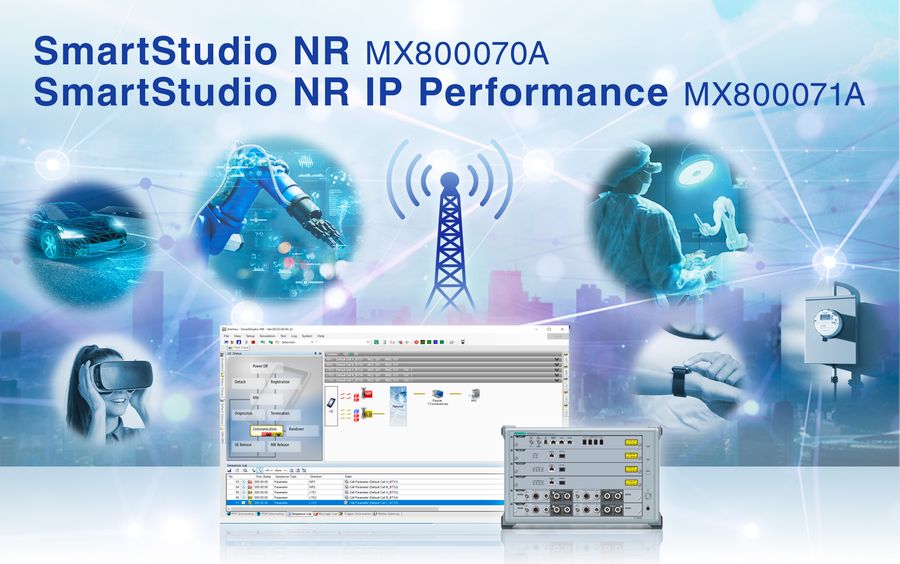
- Anritsu has announced an update to its SmartStudio NR (SSNR) and SmartStudio NR IP Performance (SSIP) software solutions.
- These enhancements integrate support for testing equipment based on 5G RedCap (Reduced Capability) technology, a variant of the 5G standard specifically designed for low-power connected devices.
The deployment of 5G RedCap is accelerating with the emergence of new industrial and consumer applications, particularly in the areas of physical artificial intelligence and the Internet of Things (IoT), including Customer Premises Equipment (CPE) and wearables. This transition necessitates validating the behavior of electronic chips and devices under real-world operating conditions, including IP throughput, power consumption, and IP Multimedia Subsystem (IMS) services.
Simultaneously, the gradual shutdown of third-generation (3G) networks is leading to frequency reallocation (refarming). This phenomenon complicates the radio architecture by increasing the number of frequency bands to support, as well as the potential combinations of carrier aggregation and MIMO (Multiple-Input Multiple-Output) antenna configurations. The proliferation of these variables increases the time and resources required for equipment validation.
Features of the updated solution
The updated software interfaces with the MT8000A series base station and core network simulator from the Japanese manufacturer. The SSIP module is configured to measure the raw throughput of IP data communication, while the SSNR module manages the simulation environment. The graphical user interface allows for the control of all tests without requiring advanced network protocol programming.
Functionally, the system now allows for the collection, in a single operation, of channel bandwidth and MIMO configurations supported by the device under test, thus reducing the need for manual configuration steps when dealing with complex combinations. The solutions cover a wide range of evaluations: in addition to throughput and power consumption, they measure component thermal rise and manage cell handover scenarios.
Finally, these software platforms enable the reproduction in the laboratory of specific or critical network configurations that are difficult to model on commercial production networks. This is particularly true for CMAS (Commercial Mobile Alert System) emergency alert management protocols or network access restrictions during natural disasters.