
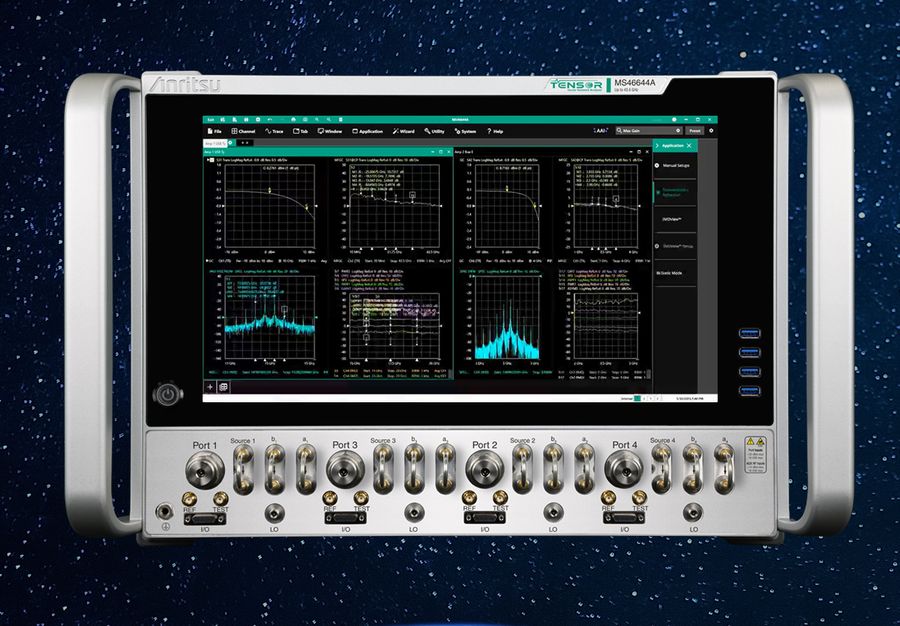

- Anritsu announces Tensor™, its new Vector Network Analysis (VNA) platform targeting applications for characterizing radio frequency (RF), microwave, millimeter wave, and sub-THz components.
- This vector network analyzer integrates a dedicated signal source per measurement port.
The platform’s key hardware feature is the systematic integration of a dedicated signal source per measurement port. Specifically, the 4-port version accommodates up to four independent sources. This configuration allows for the generation of two-tone stimuli (essential for measuring amplifier intermodulation) directly from a 2-port chassis, or the configuration of multiple complex stimuli for analyzing single-stage and multi-stage frequency mixers. An option incorporating a second local oscillator (LO) further enables vector characterization of converters (phase and group delay measurements).
On the software side, the platform integrates an artificial intelligence engine designed to guide the operator in configuring complex test benches by interpreting text queries. In terms of frequencies, the analyzer covers a range up to 54 GHz or 220 GHz using proprietary compact millimeter wave modules, and can be extended up to 1.1 THz in a banded configuration via third-party extensions.
Comparative Analysis: Tensor vs. Keysight and Rohde & Schwarz VNAs
To position this platform within the high-end instrumentation market, it should be compared to the benchmark vector network analyzer families: the PNA/PNA-X series from Keysight Technologies and the ZNA family from Rohde & Schwarz.
| Features / Capabilities | Anritsu Tensor | Keysight PNA-X | Rohde & Schwarz ZNA |
|---|---|---|---|
| Source Architecture | 1 dedicated source per port by default (up to 4 sources for 4 ports). | Up to 2 internal sources integrated in a 4-port chassis. | Up to 2 or 4 independent internal sources depending on the configuration. |
| Two-Tone Signal Generation | Achievable directly on a 2-port model (thanks to the 2 sources). | Requires a 4-port model or additional external sources. | Achievable on a 2-port model (if configured with the second internal source). |
| Mixer Characterization | Requires the second local oscillator (LO) option for vector measurements. | Second internal LO available for phase/delay analysis without a reference mixer. | Internal second LO option available to eliminate the need for reference components. |
| Interface and Assistance | Modern interface with an AI assistance engine (prompt interpretation). | Traditional software interface focused on guided metrology (dedicated applications). | Fully tactile interface focused on block diagrams and step-by-step configurations. |
| Millimeter-Wave Extensions (mmWave) | Native compact modules up to 220 GHz; up to 1.1 THz via third parties. | Extensible up to 1.1 THz via N5292A modules and third-party extensions. | Extensible up to 1.1 THz via the ZVA-Z range frequency multipliers. |
Tensor’s Market Positioning
Anritsu’s approach with the Tensor introduces a significant hardware simplification: the integration of one source per port by default changes signal flow management compared to the Keysight PNA-X, which often requires internal switching or specific multiport configurations to obtain multiple independent signals. Rohde & Schwarz, for its part, already offers a highly configurable architecture with the ZNA (up to four sources and two internal local oscillators), but Tensor distinguishes itself by standardizing the source per port without the additional cost of external hardware.
The introduction of application AI in Anritsu also marks a divergence from the purely mathematical and procedural rigor of the Keysight and Rohde & Schwarz interfaces, aiming to reduce the training time for technicians facing increasingly complex calibrations in the sub-THz frequency ranges.