
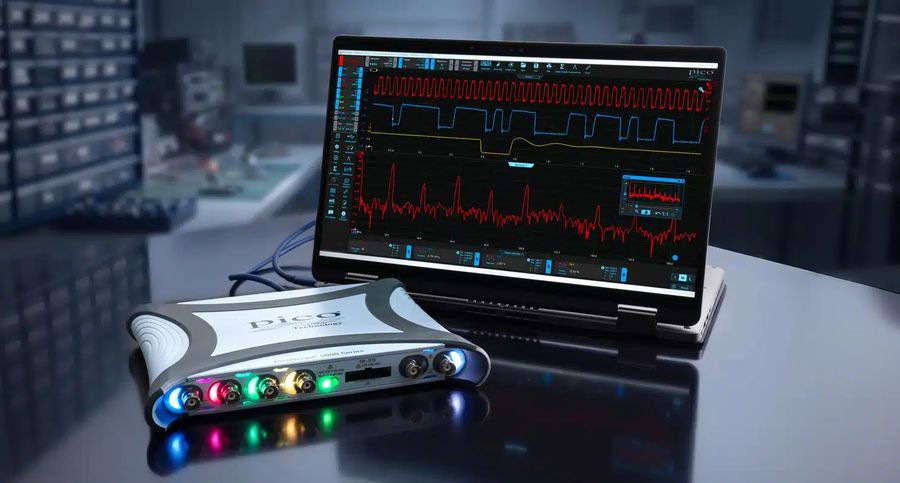
- Pico Technology announces the compact PicoScope 5000E series of oscilloscopes, distinguished by their 16-bit signal digitization capabilities.
- These modular oscilloscopes, equipped with four analog inputs, offer a bandwidth of 200 MHz, a maximum sampling rate of 2.5 GS/s, and 1 GS of internal memory.
For applications requiring higher bandwidths, the manufacturer offers “Plus” versions of this range. These models introduce a switchable high-speed mode that limits the resolution to 8 bits but extends the instrument’s frequency capabilities. In this configuration, the bandwidth reaches 500 MHz, the sampling rate is 5 GS/s, and the memory depth is increased to 2 GS. This duality allows for the use of either the precise encoding of a slow signal or the rapid capture of fast clock edges, all within a single portable instrument.
Noise Characterization and Measurement Dynamics
From a metrological standpoint, the input stage of the PicoScope 5000E series oscilloscopes exhibits a background noise of less than 22 µV RMS. The measured total harmonic distortion (THD) is less than -73 dB. These physical properties enhance the instrument’s useful dynamic range, making it possible to identify low-level spectral components, distortions, or micro-anomalies that are usually masked by the inherent noise of lower-resolution digitizers.
Multifunctional Architecture and Software Integration
Beyond its traditional oscilloscope function, the module integrates several analysis tools within a single unit. The device combines a spectrum analyzer based on the Fast Fourier Transform (FFT), a function generator, a frequency counter, and a serial communication protocol analyzer.
The MSO (Mixed Signal Oscilloscope) versions add logic analysis capabilities, expanding the hardware configuration to 4 analog channels and 16 digital channels. Furthermore, a 14-bit Arbitrary Waveform (AWG) generator operating at 200 MS/s is included for stimulating the circuits under test.
Connection to the host computer is via a SuperSpeed USB 3.0 Type-C interface, which simultaneously powers the unit and transfers data streams. This approach allows data display and processing to be offloaded to PC monitors, overcoming the resolution limitations of screens integrated into traditional benchtop oscilloscopes.
Data processing relies on the PicoScope 7 software environment.
This environment includes, as standard, more than 40 serial communication protocol decoders, mathematical calculations, automated measurement tools for power analysis, mask testing, and more. Developers wishing to design custom industrial or test applications have access to the SDK (PicoSDK), which features a unified API compatible with C, C#, C++, Python, as well as Matlab and LabVIEW environments.
Configurations and Availability
The PicoScope 5000E series is available in standard 4-channel configurations with bandwidths of 60, 100, or 200 MHz. The Plus models extend these levels under dual bandwidth and dual resolution (16 bits/8 bits) configurations, segmented into 60/200 MHz, 100/350 MHz and 200/500 MHz versions, depending on whether 16-bit or 8-bit mode is activated.