
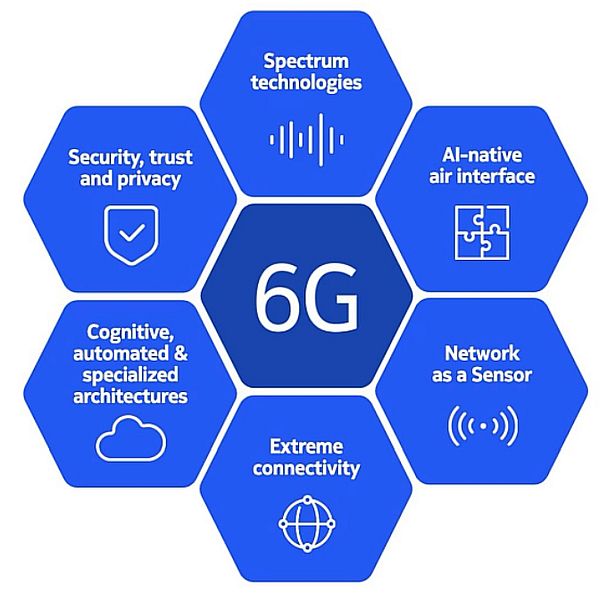
- According to Dr. Rolf Werner, Senior Vice President Europe at Nokia, the next stage in the evolution of mobile networks has little to do with increasing bandwidth or reducing latency.
- A much deeper shift is underway: networks will soon be able to sense, analyze, and interpret their environment.
- The work being done to define future 6G standards marks the emergence of a “sensitive” network, meaning one capable of detecting the physical world through the radio waves it already emits.
Until now, networks have evolved by improving their ability to carry information faster and more reliably. 5G paved the way for unprecedented characteristics—ultra-low latency, mission-critical communication, massive bandwidth—which together form a solid technological foundation for a new generation of features: integrated sensing.
In a network equipped with sensing capabilities, emitted radio signals are reflected off objects in the environment: human silhouettes, vehicles, walls, air currents, etc. By analyzing these reflected signals, the network can deduce extremely precise information: distance, size, speed, change of direction, group density, or even changes in atmospheric conditions.
JCAS: The Future Language of Networks
This new capability is based on the principles of Joint Communication and Sensing (JCAS), the cornerstone of 6G development. The goal: to make sensing a native function, not a peripheral add-on.
By multiplying radio access points, it will be possible to create a kind of dynamic “digital twin” of the physical world. With the increasing use of millimeter and subterabit frequencies, accuracy continues to improve. The greater the bandwidth, the finer the “resolution” of this digital perception becomes.
These advancements are already being tested, notably within the Komsens-6G consortium in Germany, with encouraging results in industrial environments.
A technology ready to permeate all sectors
The potential use cases are vast, encompassing both the public and private sectors.
Rethinking urban mobility: Vehicle and pedestrian detection, augmented vision to anticipate risks, improved safety in challenging conditions… 6G opens a new horizon for connected mobility and autonomous driving.
Tools for smarter security: During large gatherings or in sensitive areas, the network could detect abnormal flows, unexpected behavior, or intrusions. A discreet and privacy-respecting alternative to traditional video surveillance.
Industries: Towards truly autonomous environments. Machines could perceive the presence of an operator or a tool without relying on dedicated sensors, enhancing safety and efficiency on robotic production lines.
Healthcare: Contactless Detection: Motion measurement, respiratory monitoring, gentle monitoring of vulnerable individuals: network detection paves the way for non-intrusive telemedicine.
Network detection would allow operators to create entirely new services, based not on connectivity, but on the interpretation of the physical world.
Examples of applications related to 6G network perception:
- Dynamic traffic light control;
- Automatic tracking of logistics flows, including in port areas;
- Continuous environmental observation, without massive sensor deployment.
The network becomes a tool for understanding space, instead of simply a transmission channel.
6G as a Digital Sixth Sense
With 6G, mobile networks will become sensitive instruments, capable of perceiving and interpreting the environment. This function, comparable to a technological “sixth sense,” will open the door to new services, new business models, and new industrial applications. It won’t be magic: it will be intelligent, distributed infrastructures powered by advanced algorithms that will expand our understanding of the real world.