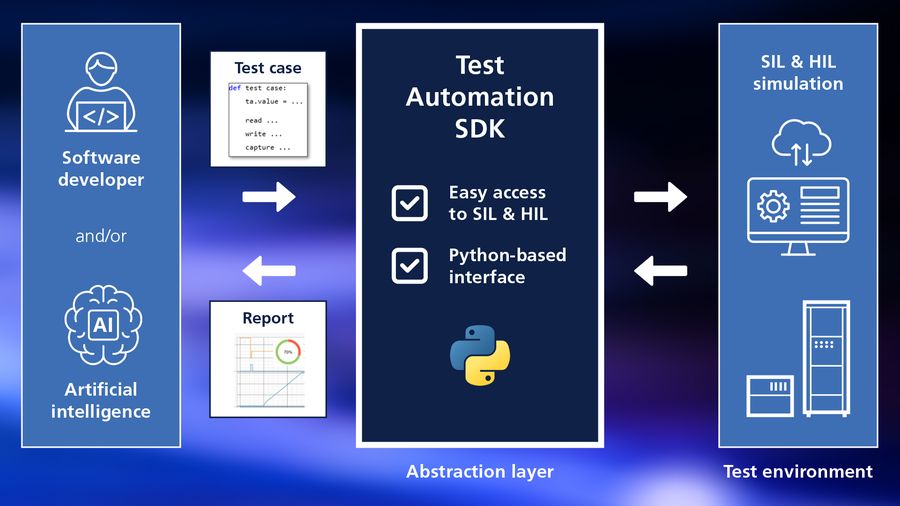
- Dspace is launching the Test Automation SDK, a software development kit designed to simplify the automated execution of tests in Python within Software-In-the-Loop (SIL) and Hardware-In-the-Loop (HIL) environments.
- This solution enables development and validation teams to create and execute test cases entirely in Python, while benefiting from end-to-end automated workflows, assisted by AI.
The SDK allows for code-based test automation, eliminating the need for multiple tools and interfaces. Users can now describe their tests as easy-to-understand and maintain Python scripts. An abstract programming interface ensures that the same tests can be reused in different environments, whether for SIL simulations on Dspace VEOS or HIL testing on systems like Dspace Scalexio. Switching between environments is done solely through configuration, without altering the test logic.
Integration into existing workflows
The Test Automation SDK is designed to seamlessly integrate with existing development workflows. It supports established Python testing frameworks, such as pytest and Robot Framework, and can be integrated into commonly used development environments, such as Visual Studio Code or Git-based toolchains. This allows software developers and test engineers to work with familiar tools while efficiently managing complex test configurations.
An open-source solution
The SDK will be developed as open source, enabling users and partners to actively contribute to its evolution. By using the widely adopted Python language and abstracting complex APIs, the SDK is particularly well-suited for generating and extending AI-assisted tests. AI-powered coding assistants can thus help developers create and maintain tests, further reducing the development effort.
SIL and HIL Testing Applications
The Test Automation SDK is designed for developers in industries where SIL and HIL testing are critical, such as automotive, commercial vehicles, off-road applications, agriculture, aerospace, and defense. In these sectors, where complex electronic and software systems must be reliably validated, the SDK enables more efficient and consistent test automation.