
- According to Anritsu, the added value of a virtual testing architecture for data centers, 5G transport networks, and edge services lies in its deployment flexibility.
- With the Virtual Network Master (VNM) solution offered by Anritsu, test points can be instantiated wherever they are needed, deployed across multiple sites, and combined with conventional instruments when physical interfaces or field conditions must be integrated into the measurement chain.
- This approach can be implemented for validation within a data center, service assurance between data centers, verification of cloud access, and testing of applications at the edge or on mobile devices.
- Real-time measurements, post-event analysis, and integration into dashboards reveal how infrastructure performance translates into the user experience.
According to Anritsu, as the architectures of data centers, transport networks, and edge services become more distributed and increasingly software-defined, operators require greater visibility into the quality of the services they provide—rather than just the efficiency of the facilities that host them.
Metrics such as Power Usage Effectiveness (PUE) and cooling efficiency remain important for operating costs, but they do not show how well the network supports actual application traffic. To ensure quality of service, the most relevant questions are whether bandwidth is available when needed, what the latency level is along the path, how stable packet transmission remains, and whether any packet loss is affecting the user experience. For engineers responsible for data center interconnection, cloud access, and fixed or mobile transport, four key performance indicators (KPIs) related to quality of service (QoS) remain essential: throughput, latency, jitter, and frame loss. Together, these provide a concrete picture of application performance across intra-data center links, inter-data center paths, and connections extending to enterprise sites, edge nodes, and mobile users.
While traditional hardware-based test instruments continue to play an important role, they are not always easy to position at the exact locations where performance issues arise. In virtualized infrastructures, multi-site environments, and third-party data center ecosystems, in particular, limited physical access can hinder deployment speed. This is where software-based test agents can complement traditional test and measurement instruments.
Validating Network Performance Without Limits
Anritsu’s Virtual Network Master (VNM) is a software-based test solution designed to extend network measurements to locations where using dedicated hardware may be impractical. Deployed as multiple virtual endpoints, it enables bidirectional quality of service (QoS) testing across both physical and virtual networks. This helps operators validate service behavior between sites, across provider boundaries, and throughout hybrid environments that combine on-premises, hosted, and cloud infrastructures.
The key QoS parameters addressed by this approach are straightforward yet operationally critical; they indicate whether a network is capable of carrying application traffic at the required throughput and consistency, and whether any degradations are likely to affect the quality of service. These parameters include:
- Throughput: the data transfer rate achieved under defined traffic conditions.
- Latency: the end-to-end delay introduced as traffic traverses the network.
- Jitter: the variation in packet transmission delay, which can degrade time-sensitive services.
- Frame loss: missing or discarded frames that can reduce quality, trigger retransmissions, and decrease application efficiency.
Since the VNM operates at the application layer, engineers can define frame sizes and data rates to emulate specific services or push traffic up to line rate, depending on the validation objective. This makes it suitable for both targeted troubleshooting and broader capacity or service verification tasks.
This approach also extends beyond the data center itself. The VNM can be used in fixed network environments and mobile scenarios, including 5G networks terrestrial and non-terrestrial. When combined with Anritsu’s physical hardware instruments, it supports bidirectional Quality of Service (QoS) assessment—covering both uplink and downlink—between the core infrastructure and distributed client terminals.
Inter-data center testing is a practical example of this. Virtual terminals can be deployed across multiple sites to characterize service performance across all possible route combinations, regardless of site ownership or the underlying provider environment. This approach provides a scalable way to verify how network behavior varies across regions, providers, or architectural domains, without the need to transport and install dedicated hardware at every location.
In one demonstration, Anritsu deployed VNM instances in European data centers located in Milan, Stockholm, and London, alongside a traditional Network Master hardware instrument connected via a standard commercial 5G service using a mobile phone. With three active traffic flows at each test site, bidirectional Quality of Service (QoS) Key Performance Indicators (KPIs) were measured across all path combinations—illustrating how virtual and physical test resources can be integrated into a single measurement architecture.
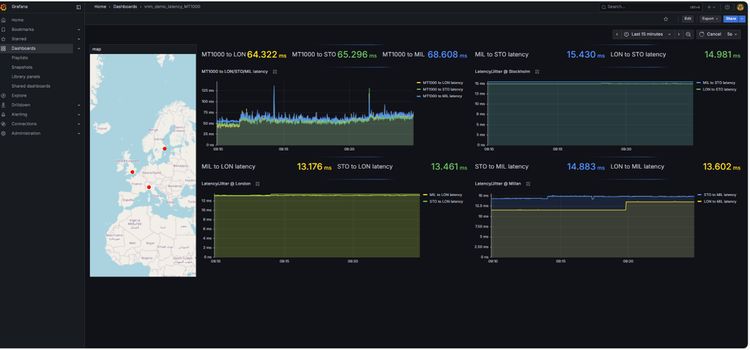
Real-time results were then presented via a third-party dashboard, demonstrating how measurement data can be integrated into an operator’s existing visibility and management environment. This offers a significant advantage for engineering teams, as test data becomes more valuable when it can be correlated with operational monitoring and used directly within troubleshooting or service assurance workflows.
The example below illustrates the multi-site deployment of VNM across the three European data centers.
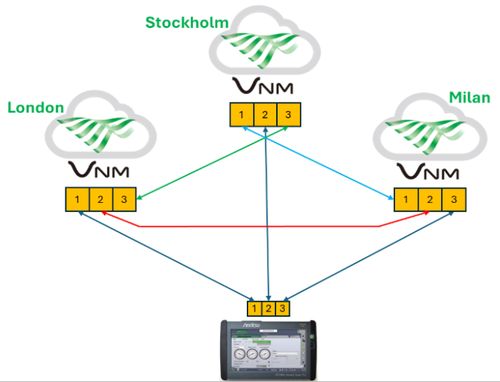
Measurement data can be visualized in real time and correlated with network topology and service paths.
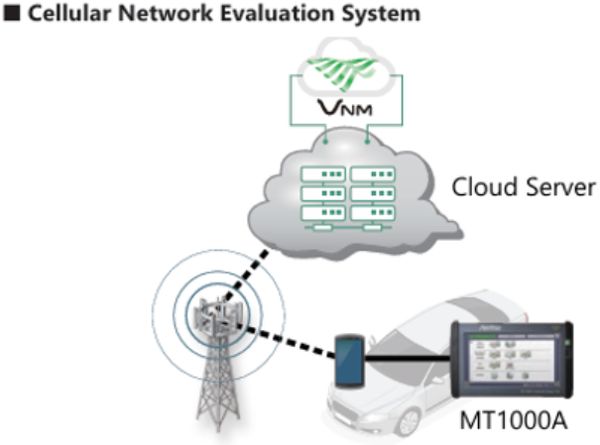
This same framework can also be applied between a client terminal and a central exchange or a cloud site. This is particularly relevant for connected vehicles and other edge-computing applications, where service continuity depends on stable performance across public mobile networks—not just within the core infrastructure.
 For instance, an infotainment or telematics development platform installed in a vehicle can be tested against an OEM’s data center to evaluate how well critical applications are supported across various mobile network operators. This not only helps the application provider validate service performance but also gives the network operator visibility into coverage quality and the consistency of service delivery under real-world operating conditions.
 When results are correlated with GPS location, performance can be mapped geographically, showing how latency, throughput, or other parameters vary along a route or within a coverage area.
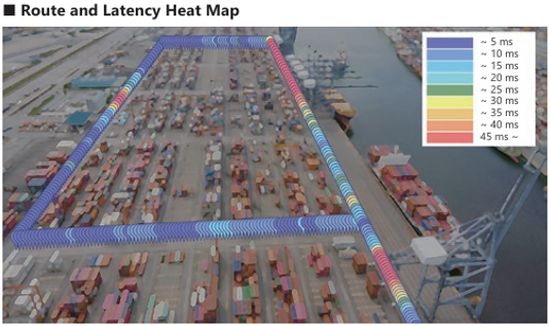 The chart above provides an example of downlink latency visualized geographically.