
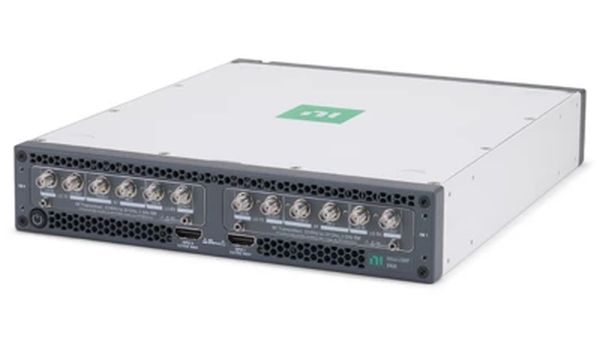
- Emerson has announced the launch of the NI USRP X420, a new software-defined radio (SDR) device developed under the NI (National Instruments) brand.
- This device is designed for prototyping and research in the fields of radar systems, satellite communications, and future 6G mobile networks.
The NI USRP X420 module is distinguished by its extended frequency coverage, now reaching 20 GHz. This hardware feature allows engineers and researchers to directly access several portions of the high-frequency electromagnetic spectrum without requiring external conversion modules.
The instrument thus covers the FR3 frequency band (currently being studied for 6G), as well as the X and Ku bands. These spectral ranges are primarily used by multichannel radar architectures, non-terrestrial telecommunication networks (NTNs) integrating satellites, and emerging Integrated Sensing and Communications (ISAC) systems.
Multichannel Architecture and Phase Coherence
From an electronic architecture perspective, the platform incorporates a local oscillator (LO) sharing device across its various channels. This technical feature ensures phase-coherent operation across all channels of the device.
In the aerospace and defense sectors, precise phase synchronization is essential for implementing technologies such as beamforming, multiple-input/multi-output (MIMO) radars, and distributed detection systems. By integrating the local oscillator distribution directly within the chassis, the X420 module reduces the need for external hardware synchronization devices, thus simplifying the wiring and configuration of multichannel test benches.
The system also features instantaneous bandwidth (up to 1 GHz) sized for capturing, analyzing, and generating broadband signals. These capabilities are used for radio spectrum monitoring applications, as well as for RF record and playback.
Sarah LaSelva, product marketing manager for RF and wireless solutions at NI Emerson, explains that the platform’s software design aims to provide a modifiable environment to adapt to standardizing protocols, while maintaining physical processing characteristics comparable to those of traditional laboratory measurement instruments.