
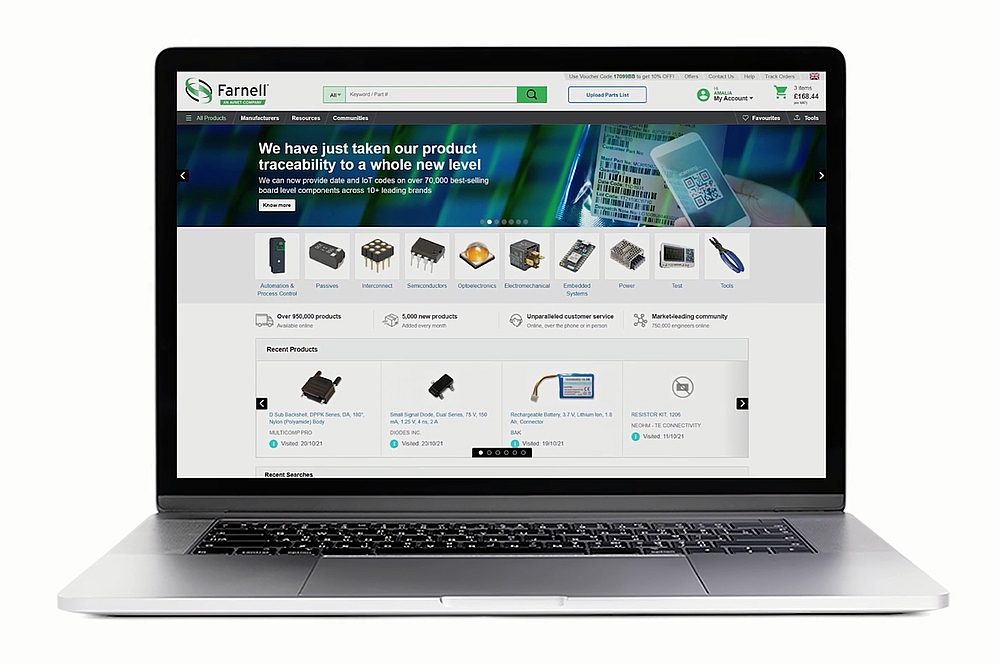

- Dan Ford, VP of Sales, EMEA, at Farnell, believes engineers have shifted from prioritising what is technically the best product for the job to selecting components that offer strategic fit and long-term viability.
- Procurement professionals in the electronics industry always face a dilemma when looking to source products: They must decide what criteria they use to determine which product is the most suitable.
We might like to believe that products are sourced following meticulous research to find the most optimal component for the job in hand – but often the reality is different.
The trend to prioritise purchasing a product that is not technically the best for the task in hand isn’t one borne out of laziness or ignorance. Far from it, engineers faced with short development cycles and supply chain pressures are making their decisions based on legitimate considerations of time-to-market and long-term viability. Components that are deemed to be ‘good enough’ will be chosen if they meet baseline design requirements and align with strategic goals. These can include supplier stability, ecosystem compatibility, lifecycle efficiency and future scalability – even risk mitigation.
A technically superior (but perhaps less sustainable) product may be overlooked because the procurement professional is focused on choosing a solution that is strategically aligned and can deliver greater overall value. The truth is that with widespread feature parity in components from most suppliers, a ‘good enough’ product could give design engineers greater flexibility. It likely will also satisfy concerns over design costs while familiarity of the type of component will make it easier to integrate.
New products take considerableinvestment
Most engineers will understand that having to switch from one manufacturer of electronic components and semiconductors to another in order to source a technically better product would involve considerable investment, either in new tools or in time spent getting up to speed with the new supplier’s product architecture. There is usually a very steep learning curve associated with moving to a new supplier, especially in terms of training and becoming familiar with all the relevant documentation. Rather than engineers taking a risk to obtain the best product for their needs, it’s much easier for them to stay with the current supplier, a known entity that can be relied on to support the designer’s current and future requirements.
Sustainability is another key consideration in the minds of those procuring products, including whether they will need to be replaced at more frequent intervals than other components. Built into this decision-making process are all the additional manufacturing and logistics costs that can be involved, as well as lost time and the disposal of spent parts. It makes more sense to choose products that reduce waste and minimise impact on the environment. Such products often align closely with the latest corporate and regulatory sustainability goals of that company.
With the increasing complexity of modern components, design reuse has become a more important consideration, not least because it improves time-to-market but also because it allows smaller teams to work on more complex products. By reusing proven solutions, teams avoid reinventing the wheel. They also speed up development and minimise errors, while boosting reliability, fostering standardisation and supporting scalability. Design reuse also encourages knowledge sharing across teams, streamlines maintenance and promotes productivity and innovation by allowing designers to focus on new challenges.
Limitations of strategic sourcing
Unfortunately, there can be downsides associated with this drive of engineers towards system-level performance rather than component-level perfection. The former approach has meant that they have eschewed enhanced functionality in many cases while there has been a negative impact on much-needed innovation. Innovation is the life-blood of the electronics component sector and anything that holds it back is not something that we should countenance.
It’s clear, then, that component manufacturers need to offer more than just a technically superior product if their components are going to stand out and be chosen by engineers. They also need to deliver value-added services to engineers and manufacturers, such as design support, toolkits, training and detailed documentation for more efficient integration and troubleshooting.
Engineers and OEMs increasingly want to take advantage of services that streamline product development and reduce time-to-market. They also want to establish and invest in solid, long-term partnerships with engineering teams and OEMs to get the best from each. It is vital to foster trust and reduce any kind of ‘friction’ across design cycles. Mutual understanding goes a long way to achieving that trust and it encourages collaborative innovation.
Manufacturers who embed themselves in the development process are able to anticipate needs better and to adapt their product offerings. Ultimately, all parties can become indispensable allies in delivering high-performance, future-ready solutions.
Now we’re seeing a change to the definition of ‘best’ product. It’s more important than ever to be forward-looking, to factor in more than just technical specifications in product selection and to bring in all the other factors mentioned above.
The process for forward-looking product selection now needs to look beyond such concepts as long-term component availability, supplier stability, compatibility with existing platforms and scalability. Genuinely forward-looking selection means taking a holistic approach to evaluate the broader context – such as supply chain resilience, roadmap alignment and total cost of ownership. This approach ensures products not only meet current technical needs but also support sustainable innovation and operational continuity over time.
Early engagement
There is a clear need for procurement to engage early in the engineering design process and to influence supplier selection, ensuring full alignment with technical and commercial objectives. Early collaboration enables smarter decisions and aligning technical requirements with commercial realities. It fosters proactive risk management and better negotiations, while ensuring the suppliers chosen can support innovation, scalability and long-term business goals.
The shift towards engineers no longer prioritising purchasing the best product will impact the industry significantly, as innovation will no longer be focused on component features and functionality, but rather aligning with long-term business goals.
At Farnell, our commitment is to enable all stakeholders across engineering, procurement and manufacturing to reap the benefits of the most advanced solutions available and not to compromise when it comes to product selection. Let us all put ourselves in the position where we can meet strategic targets and policies and keep design issues to an absolute minimum while at the same time always having the best possible product installed in devices that have the potential to change the world.