
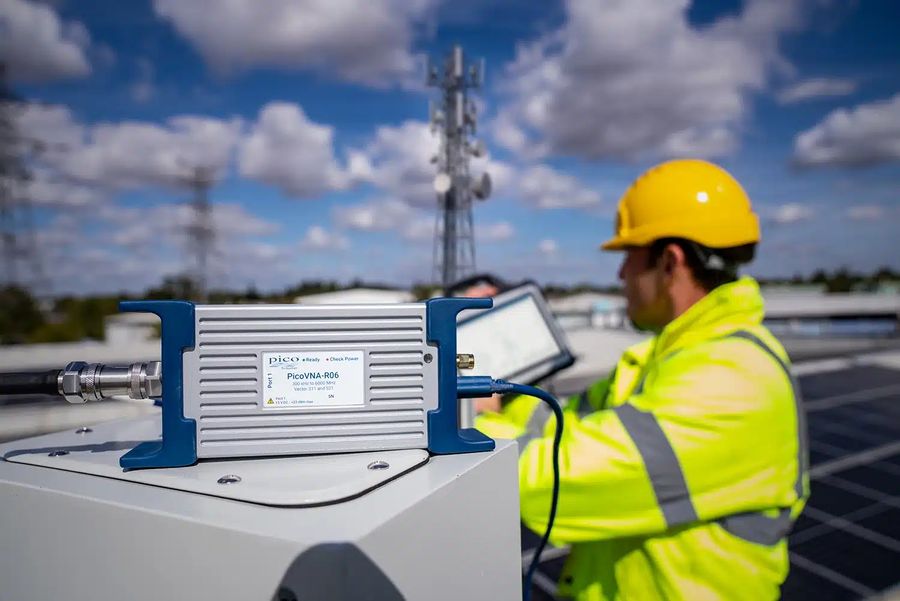

- Pico Technology expands its range of PC-based test instruments with the PicoVNA-R portable vector network analyzer (VNA), covering a frequency range of 300 kHz to 6 GHz.
- Designed primarily for characterizing antennas, cables, and passive components directly at the installation site, it measures the magnitude and phase of S11 and S21 parameters and also incorporates time-domain reflectometry (TDR) functions.
The instrument comes in a compact housing measuring 187 x 81 x 41 mm and weighing 0.47 kg. It is powered and controlled via a single USB-C connection, which handles both data transfer and power supply. The British manufacturer notes that no dedicated mains power supply is required when performing measurements with a laptop or tablet.
Vector measurements and fast sweeps
The PicoVNA-R performs magnitude and phase measurements on S11 and S21 via two N-type female test ports. According to Pico Technology, an S11 measurement point is acquired in less than 100 µs. Consequently, a 201-point sweep can be completed in 20.2 ms under the stated conditions.
This speed allows users to monitor response changes while tuning an antenna or diagnosing a circuit, without waiting several seconds between sweeps. The manufacturer also specifies a typical trace noise level as low as 0.008 dB RMS.
S11 and S21 parameters are used to characterize the reflection and transmission of a device under test, respectively. When combined with phase measurements, this data can be used to analyze antenna matching, filter insertion loss, or the characteristics of a coaxial link.
Integrated electronic calibrator
Vector measurement generally requires calibration to account for errors introduced by the measurement setup, particularly those caused by the cables and connectors used. These errors can also fluctuate with temperature, posing a challenge for measurements performed in variable environments.
To address this, the PicoVNA-R incorporates an electronic calibrator. It measures and stores internal module calibration data, allowing the calibration to be restored after power-up under similar conditions. Pico Technology states that a new characterization can thus be performed in just a few seconds.
The specified temperature stability is 0.03 dB/°C up to 4 GHz and 0.05 dB/°C between 4 and 6 GHz. For applications requiring calibration using known, traceable standards, the manufacturer also offers manual SOLT kits covering the same frequency range. A USB-controlled E-Cal module is also available; it is characterized using traceable standards up to 8.5 GHz, exceeding the PicoVNA-R’s maximum frequency.
Time-domain reflectometry
The PicoVNA-R includes Time Domain Reflectometry (TDR) and Time Domain Transmission (TDT) functions. These functions leverage frequency-domain measurements to analyze link behavior in the time domain and locate discontinuities along a transmission path.
This capability can be used, for instance, to detect faults or impedance variations in a cable without needing to replace or add a dedicated hardware module. Results can be examined alongside frequency-domain measurements.
The PicoVNA 5 software provides frequency- and time-domain displays as well as a Smith chart. It allows for multiple independent workspaces, each with its own settings, data, and calibrations. A wizard guides the calibration process by indicating which standards to connect and displaying their measurements.
A housing designed for on-site measurements
The PicoVNA-R unit features an IP66 rating for protection against dust and water ingress. Its dimensions and weight (0.47 kg) make it suitable for use with a laptop or tablet. Since power and data communication are handled via a single USB-C cable, the device does not require a separate mains power supply.
The PicoVNA 5 software is available for Windows, macOS, Linux, and Raspberry Pi OS. According to Pico Technology, the full feature set is included without the need for additional software licenses. The instrument can also be automated via an API—with examples provided in C, C++, and Python—or through a SCPI remote interface.
The PicoVNA-R is marketed under the model number PicoVNA-R06 at an advertised price of £3,215 (approximately €3,747).